Saturday, 23 January 2016

R1: Nellie James Too


Review 1: Nellie James Too

Allow me to take a quick moment to repurpose this blog a little. Since the scope of my new job doesn't really afford me the luxury of resculpting the culinary landscape, I've decided to review local restaurants, instead. Consider it a hobby as I enjoy semi-retirement.

First up is a little place on James Street South called Nellie James Too. It is located at the corner of Duke and James, and is in the spot that Boo's Bistro and Wine Bar used to be situated. It is owned and operated by Ken LeFebour and his partner, Jackie, who are also owners of the reputable and popular Chef & Wife establishment in the heart of downtown Dundas, ON. It has since been renamed Nellie James Gourmet Food To Go. The resto on James, ostensibly, as one would garner by the "too" appendage of the nomenclature, is a sit-down extension of the Dundas store.

On first approach to the restaurant, the initial vibe is classy, welcoming and modern. It sports a glasshouse store front and a small staircase leading down into the dining room, making it non-wheelchair accessible. Service staff were friendly and quick to greet, and the coziness of the dining room was quite welcoming. The walls are adorned with kitschy artwork, and the banquettes are clad in a black-and-white pseudo animal print, which adds to the overall modern, funky and textural feel of the establishment.


The menus are blackboard based, which for me is two-fold: I appreciate the blackboard menu movement, as it is very trendy, but I have largely seen blackboards written by people who have little business holding a piece of chalk or a dry erase marker. This isn't just a Nellie James Too problem, it is a blackboard menu problem all over, by nearly everyone who attempts one. Perhaps I am being overly critical, but blackboard menus are meant to be illustrative, neat and well laid out...eye catching...to draw the diner to buy-in. I believe blackboards should be filled out by those with a flair for handwriting and lettering, but I digress. A small niggle, really. Moving on!

Daily Menu Slate


The menus were presented on slates with handles, with content that is changed daily, based on Chef Ken's whimsy. I found this to be a very creative and interesting way to present his daily card. The variety on this day certainly did not disappoint. Price points were very reasonable for gourmet cuisine, and Chef Ken has hit all the right bases here.


We were sold a bottle of California's Menage-a-Trois by the knowledgeable and personable bartender / maitre d'. It was a very pleasant, easy drinking and fruity bottle of wine, that was a pleasant aperitif, especially when paired with the complimentary house made potato bread, paired with a lemon herb aioli. The bread was moist, rustic and delicious, complete with chunks of tender potato baked in, and the aioli was replete with citrus, and very savoury.


Blackened Shrimp

 
The Cajun shrimp were presented simply, over a flavourful smoked cheddar potato pancake, crisp sauteed bok choy and a coconut lime broth. It came with three jumbo shrimp, and, while not easy to share with another, were well seasoned and perfectly cooked. The grilled lime was a nice touch, and the denatured juice livened the coconut broth up considerably. The bok choy was a little undercooked, though...not sure if this was the intent of this preparation, but it was still good, offering crunch, and varied texture. Perhaps maybe an avant-garde slaw?
Duck Burger
The mains arrived next. Despite being somewhat busy (they had about 16 covers on the go in a 25 seater), the timing was very good. We were never left to wait and wonder, and the staff was quite engaging and always struck up casual conversation in the interim. The first entree was their lauded Duck Burger, which I had heard about during a city-wide Hamilton burger promotion in November (Novemburger). They were happy to mention that it had been added to their menu based on popular consensus. It was cooked medium-well, nicely seasoned, over a slice of smoked cheddar toast, with parsnip chips and a house-pickled red beet. The portion was quite generous, and the duck was flavourful and delicious. I would have preferred medium done personally, but I completely understand the impetus on restos to serve medium well and up. The gastrique on the side was an interesting foil to the duck's richness.

Grilled Lamb Shoulder Chop
The other main was a grilled lamb shoulder with rosemary pan jus, and the very same beet and parsnip chip garnish adorning the duck burger. The server advised, before ordering, that the lamb was best grilled rare to medium rare. I found that unusual, as lamb shoulder can be a bit sinewy and a generally chewier secondary cut. Rare to medium doneness is usually reserved for the prime cuts of an animal. However, it was ordered as recommended, and while the flavour of the lamb was great, it was indeed a cut of meat that needed to be cooked up a few degrees, to medium or medium well, to be enjoyed more. The rosemary pan jus was very flavourful. The roasted garlic mashed potatoes that were ordered as an accompaniment were very garlicky and creamy.


Daily Dessert Slate
Pink Peppercorn Chocolate Tart


After the mains were cleared, dessert was the next on the agenda. The dessert slate I was presented with offered several house made creations. This, like their regular menu, changes often. I opted for the chocolate and pink peppercorn tart, and I was not disappointed. The chocolate ganache was spot on, and the salted caramel sauce was delicious...a match made in heaven. It was topped with a quenelle of homemade whipped cream chantilly, and an overly large piece of sugarwork garnish. This plate as a whole worked well, and was a memorable finisher to a great meal.

THE VERDICT:
 
Great homemade gourmet meals in a modern setting. Friendly and accommodating staff. Very reasonable price points. Menu changes daily.

Nellie James Too is a solid part of the modern renaissance the Hamilton culinary scene is currently experiencing. Because of places like this, Hamilton is quickly becoming a hotbed of epicurean destinations!


Kudos to Ken, his wife and their staff for a great meal. Will definitely be back! 

Cheers, Chef D


Saturday, 10 May 2014

Hit The Road, Jack: Version Me

Hello...it's been what seems like a quasi-eternity since I have posted anything at all on this blog. Like all my interests, they pass and return...the eternal ebb and flow. I am thankful I have remained so committed to running for the last 2 years. I think maybe it was the fact I had so little to say over the last year. It has been a whirlwind. Upset apple carts and whatnot. Endless reflection in the past while has prompted me to make some changes; mostly major, and hopefully for the better, to get things back on track. I will try to avoid sounding self-serving as I write this, but I guarantee nothing.

I have recently decided to move on from a job that I have held for the last 14 years, on and off (but mostly "on"). Feelings of stagnancy and spinning my wheels in vain had supplanted the joy, passion and gratifying sense of accomplishment I had once felt toiling in the very same role. Things changed. Circumstances changed. People changed. The whole playing-field became razed...not unlike a modern day scorched earth. The collective vision of the powers-that-be, in my estimation, became fragmented and disjointed...even corrupted. The confidence people once had in me had somehow been replaced by some pseudo-delusion of malcontent...either perceived or real (the jury is still hung on that one).  The trickle down of all this is what you see here before you. I suppose this sort of thing is inevitable...expected, if you will...especially after all these years. But it made the decision to move on no less difficult. The decision to leave something so comfortable and routine and step outside of my self-imposed box was very challenging. It seems the old dog needs to learn a few new tricks...and in turn, make a few concessions...to make status quo moving forward. Ain't nothing like a good life overhaul to shake things up a bit.

At the end of the day, in my wake, I have left something I will miss dearly. There were so many pros and cons, but at the end, it seems I have made a decision for the better. This view is shared unanimously with my colleagues...ones who are, like me *now*, on the outside peering in. I suppose only time will tell as I plunge headlong into the great unknown...that swirling, gaping abyss of which I have gambled a great deal on. Who knows? This could be the greatest thing I have ever done, or it could possibly be the biggest misstep I have ever taken. The  mistake was mine to make. Can't ever wonder what it would be like on the other side if one doesn't ever dream of taking the risk. This one was many years in the making...whether I was willing to admit that to myself or not.

I would like to thank all those who have stuck by my side throughout the years. Their hard work, determination and loyalty were all driving forces to me. I reserve a special place in my heart for each and every person who fought the good fight with me each and every day.

The old cliche holds true. Everyone is replaceable. And it seems I will be too, in time.

Thanks for everything!

-D

Saturday, 4 May 2013

Oh, the Humanity


 Oh, the humanity...


 I enjoy writing. I always have. It seems to serve me well as an outlet to my absolutely raucous mind. I have to share that...it is a virtual tempest of baggage, things to do, problems, micro and macro crises, trials and tribulations....dotted with dreams, longings and aspirations. And oh, there are longings. And there's the recently identified mid-life crisis.....the recently acquired red sports car, the desire to eat well, running to stay in shape, doing yoga to become more flexible and zen, and to look as good as I ever have. And there is the proliferation of beginning multiple sentences with conjunctions. But I digress. Damn.


There is only one thing more liberating to me than putting on a pair of running shoes and taking off on a run of unknown length and duration. That would ostensibly be cracking my laptop and putting fingertips to these stupid chiclet-style keys computer builders are so keen on putting on portable machines these days. If only I could master that damned SHIFT key. If you encounter a stray lower case "i", please know it to mean "I". i, no...*I*, would be eternally grateful. Hell, if it wasn't for this keyboard, I would have nowhere to channel this overly verbose tripe, and I would likely explode. And that would leave a mess.

There is something quite gratifying about putting these thoughts down in soft-copy. It is sort of like a cache cleansing on a bogged down PC. I am rampant with so many random and disjointed thoughts throughout any given day, that an outlet is almost academic. Needed. Required. I am surprised I get any sleep at all, really. Let me tell you my thoughts on people. People you may work with or live with. People who seem to make the clock hands move quicker during the day, and those who seem to make them move slower, stop, then move backward.

As a manager, one must assume the responsibility, at least as a sympathetic ear, to other people's problems...at least to a degree. As much as it seems ridiculous as an idea, it is absolutely key to understanding other people. Walking a mile in their shoes. Being in their head. Understanding the whats, whys, whens, and occasionally, the elusive hows. Being sensitive to their situations....their little microcosm, their "slice" of this bigger thing smarter people than I haven't figured out yet. To what end? Simple. To be an effective human resources officer, you have to understand and decipher the "human" part. People can be strange, so very, very strange. Yet, people can also be wonderful. There is just so much grey between those two lines, that it seemingly boggles the mind. For example, there are some people who you may not be able to make eye contact with, because of how awkward they make you feel. The sound of their voice and the content of their dialogue makes you cringe. The Strange. We all know a few, and I am no doubt one of them to you. Others, the wonderful, make you jump out of bed every morning with such vigour, so that you can spend the most time possible with them, to see where they may take you and what yarns they may spin. The "greys" are usually acquaintances, of increasing degree of familiarity. All of these makes up the whole. The battle to figure out what makes people do what they do is elemental to figuring out the "human" aspect of human resources.

I have always regarded Human Resources as the most challenging aspect of management. People provide such infinite variables. Every single person is their own little enigma, wrapped up in a riddle, and stuffed deep inside a paradox. So incredibly beautiful, yet, somehow, so incredibly bizarre. One cannot ever hope to understand everyone. But having a little insight, a little sympathy, and some empathy and understanding of what makes other people do what they do, and act how they act, will provide a good basis in the fundamental. The puzzle that makes up human nature has baffled even the most foremost psychological minds.

Here is how I explain the science of Human Resources, when it all boils down: I find that people, ALL of us, are akin to a jigsaw puzzle that lacks that *one* missing piece to mark it's completion. It's not absent or hidden on purpose. Not at all. It's vacancy is meant to be filled with a modicum of understanding and compassion from someone else. That completes it, really and truly. I'm not sure I can make it any clearer than that, especially at this hour.

I suppose I just need to not take it so personally sometimes.

Thanks for making it this far.

Cheers
-D


Friday, 26 April 2013

Flaying the Beast


" Flaying the Beast "

Or,

 "More than you ever wanted to know about basic butchery"


At some point, I really wanted to write a blog discussing the fine art of beef striploin butchery. No time the present, I say.....So, I took some pictures recently of the steps I took when I actually prepared a raw beef striploin, and turned it into steaks and usable trim. Maybe you've had a hankering to purchase one of those daunting whole AAA striploins in the fresh meat department at Costco, and were wondering, deeply, how you may go about breaking it down? Fear not. I have arranged this easy to follow tutorial, for your degustation and perusal. Fair warning though; it does get quite bloody, and you will need several tools you *may* not have in your home, or within easy procurement. If the sight of blood and animal tissue offends you, please feel free to re-read my previous blogs, and move on. :)

First off, you will require a sharp boning knife and/or a carving cimiter, a large cutting board, lots of paper towels, or a clean absorbent towel or rag that you would consider disposable after this. The cimiter is the desired blade of choice for this, but the more common boning knife works just fine in a pinch. Just make sure they are very sharp. Nothing in the kitchen is more unsafe than a dull knife. Why? You overcompensate for the lack of precision cutting with what turns into frustration and reckless force...this is bad. So, sharp knives only, please!

What I have pictured here is your standard 0x1 Reserve Angus beef striploin. It weighs in at an average of 11 lbs....the perfect size for cutting steaks of proper length and thickness. Signatures of quality beef striploins are: size -- not too big or small, eye -- not too large or small, fat -- milky white and solid, and a 1/4" fatcap, and marbling -- prevalent. I will describe what marbling is a bit further on.  Striploin is one of the most revered cuts of beef, coming from the shortloin, which is between the prime rib section and the sirloin section, working nose to tail. Have a quick look at the diagram at the top of the page for reference.

To begin, make sure you have a clear and clean work surface. Place a damp cloth under your cutting board to prevent sliding. Remove the striploin from the vac-pac bag it comes in. I normally flip it over revealing the underside, and run my knife gently along the length of the bag, just enough to smake an opening, but not enough to damage the underlying meat. Grab the loin firmly, and pull it out of the bag, making every attempt to leave most of the blood behind, inside the bag. Discard the bloody vac-pac bag, and place the strip down on your cutting board. Give it a good wipe with plenty of paper towels, or your cloth or rag, to sop up any extra blood. What you should have is illustrated below. Notice how the "tail" of the striploin is oriented away from you. The tail side is the side that slopes downwards. The backstrap is somewhat flat and squared off in section.


 The first cut we will make is to remove the backstrap. The backstrap is the thick chord of elastin and other connective tissue that runs along the back of every beef striploin. You want to remove it, as it is very chewy and largely inedible. Removing this is called the "New York" cut. I start about 2" in from the back, and cut towards the outside, then straight down, to effectively remove all of it....illustrated below.


Next, turn the striploin around so the tail is now facing you. I choose to remove most of the tail, as the excess fat rendering just causes flare-ups on a grill. Run the knife lengthwise down the length of the strip as illustrated below. You can see the shape of the classic New York steak being revealed.


What you have left should be this. You can choose to remove some of the excess fat-cap if you wish. I remove some of it, but not all. Most "better" strips come with 1/4" of visible fat-cap, which is within normal tolerance. I just shave off some of it....just remember to cut away from you, not towards!


 Next, turn the striploin over to expose the underside. there is some fine trimming to do here. The white bits are inedible connective tissue elastin) and silver skin. Leaving this on will make the resultant steak very chewy.

 Run your knife parallel to the table, as illustrated below, along the bottom of the strip, removing the silverskin and tissue, all while trying to leave the actual meat intact.


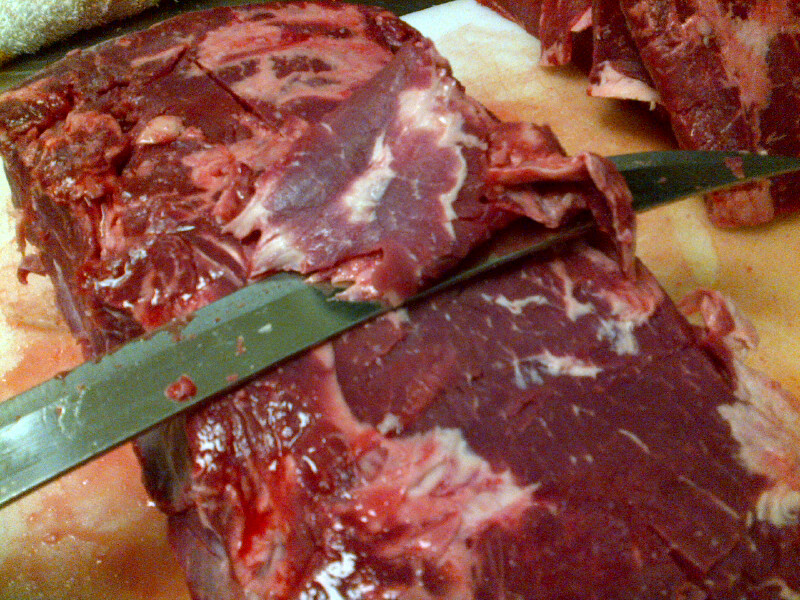
When that is done, flip the striploin back over, with the tail part oriented towards you, backstrap facing away from you, as illustrated below. Now fun part begins! Now you can cut steaks to your liking, as thick or thin as you like. Cutting steaks by weight accurately, while minimizing waste and mis-cuts, takes a great deal of experience. The steak I have cut is an 8 oz. steak. It is about 10-12mm thick. This will vary by striploin, as none are ever truly alike. Keep cutting steaks until.....

....you reach what is called the "tissue end". The tissue end is where the striploin interfaces with the sirloin part of the animal. You will notice a curved arc of gristle that makes its way through the top middle part of the steak. These cuts are generally not served to paying customers. The gristle is quite inedible and chewy. I always break down the sirloin end of the striploin into what I call "usable trim".


 To create "usable trim", remove all of the fat-cap from the sirloin end chunk that you have left. You will find a knob of meat overtop of a thick bandof gristle and silver skin. You can see it in the picture below. I had removed this knob of meat for the sake of a photo. You can see it on the left of the knife. The removal of this gristly band is next. You physically want to excise this, so just run your knife under it, following the band, and remove it.


What you will be left with is this: Usable Trim. It is great for a multitude of things....stirfries, curries, fast fry steaks, stewing beef, etcetera.

To break the usable trim down further, we need to slice it into manageable pieces. I always prefer thin slices, for use in stir-fries, curries and pasta dishes. In the above picture, the grain of the meat (the direction of the muscle tissue strands) runs *lengthwise*. Therefore, the grain in the trim in the picture above is running from the top of the photo to the bottom. You want to slice *against* the grain, that is, *across* it. I break the above trim chunk down further into 3 somewhat equal size pieces grain-wise, thne proceed to cut slices against the grain, like what is pictured below. Slices cut with the grain will be stringy and chewy. Against the grain cuts will result in greater tenderness.


The above steak is a perfect New York steak. Minimal fat-cap, no backstrap and no elastin underside. Ready for marinating. Notice the marbling----the intra-muscular fat deposits, or 'white-streaks' in the steak. This is highly desirable, especially where tenderness, juiciness and flavour are concerned. The more "marbling", the better. The most marbled steak I have ever encountered is Wagyu (Kobe) beef:


Now, *that* is marbling. It also costs $35-$40 or more per pound, whereas the strip I butchered comes in at about $8 per pound. It may look enormously fatty, but the cooked version is super tender and succulent. The intra-muscular fat aids in "self-basting" of the steak during the cooking process. Steaks of this caliber are often served RARE and cooked over very high heat, for a good sear, which locks in the juices.

I hope you enjoyed this mini-lesson of basic striploin butchery. If you followed along correctly, no doubt you will have some great steaks to grill. A simple marinade of chopped garlic, sea salt, cracked black pepper and rosemary leaves works great, with a splash of red wine and a little olive oil to coat.

As a footnote, I also make use of the inedible trim (the backstrap, the tail, elastin trim etc.)...I roast it in a hot oven on a tray til it's sufficiently browned, then I simmer the roasted trim in enough water to cover it in a large pot. I deglaze the pan with red wine, add the drippings to the pot, with some mirepoix (diced celery, carrots and white onion), and some bouquet (stems of parsley, bay leaves and whole black peppercorns). I let this simmer for a few hours,or even overnight on LOW sometimes, then I strain it and use the resulting liquid as a base for gravy, au jus or even soup. French Onion soup comes to mind here. I will add a recipe for a *killer* French Onions Soup after the jump. The flavour is much better, more homemade, than using overly salty beef base or bouillion cubes.

Have fun, and remember: ALWAYS CUT *AWAY* FROM YOU!

And don't run with scissors, too.

Cheers
D

Sunday, 21 April 2013

Hitting the Road, Jack


"Hitting the Road, Jack."

...or, A User's Guide to Industry Transiency


I woke up today and decided to jot down a few disjointed thoughts on one of the main and most prevalent distractions in the foodservice industry.......transiency. Be it through termination, relocation, or the desire to move on to the proverbial greener pastures, it is one that is redolent among those who toil in foodservice. Make no mistake, all industries demonstrate a degree of employee transiency. It is human nature for employees to want to go abroad and do something that they feel will make them more whole. Fair enough. But in some cases, especially where I am concerned, it doesn't ease the sting any. I have been experiencing more than my fair share of it lately. The real rub here is losing that personal contact with friends and colleagues when they decide (or have that decision made for them) to weigh anchor and sail on.

Colleagues are very special people. They wear alot of hats for me in my life. They are the shoulders to cry on, the sympathetic souls who gladly lend an ear, the people who fight the very same fight you do, and the confidantes you sit down with after work and share a drink with. Their presence is my life has been and always will be....invaluable. Unfortunately, at some point, they all ultimately pass through that revolving door, easing so brutally and suddenly in and out of my life; the old, comfortable and familiar being replaced with the shiny, the new and the strange. The endless cycle. The most peculiar thing about this sort of relationship is this: you have to share the common fight. Once that strand is broken, future conversations and interactions become increasingly more difficult, and perhaps strained. It is truly that common fight that binds colleagues, and brings them together. It is such a precious, delicate strand.

I wish to convey my sincerest good tidings to the two people that have found the doorway out most recently, by means of their own, or by circumstances beyond their control. I envy your courage, your outlook, and the fresh start elsewhere that awaits you. Somebody out there is going to gain a couple of really good colleagues. Thanks for all the memories, good times, and the laughs.

The revolving door spins again.

Please don't forget to visit.  I have the barstool waiting, and the glass is on ice.

-D


Thursday, 18 April 2013

And It Begins...


Ahhhh.....spring time. In Southern Ontario. A little later than usual this year, but she is a welcome bird nonetheless. Time to put away the heavy coats and snow brushes, clean up the yard, and to take the winter tires off the car in favour of something a little more sporty.

And patio season at the Burlington Waterfront, and at restaurants around the world.

It's around this time of year that I begin ramping up and preparing for the busy season, which begins promptly at sunny-warm-day-o'clock. If you're unprepared, mayhem ensues. Good thing this is not my first rodeo. Believe me, you only get exposed once or twice before you have to make the necessary corrections, or else summer will become the most dreaded time of year. it doesn't necessarily have to be, at all. Staff need to be hired and trained, mentalities need to be adjusted, par levels need to be upped, menus need to be written, processes streamlined, and above all else, a gut needs to be checked. It's going to be a long 6 months until September (the soft ending), and alot of blood, sweat and tears will be spilled in that time. More sweat than tears or blood, hopefully.

I have fully bought into the notion that I improve every year: Techniques are perfected. Scheduling is honed. Methods and strategies are polished. All of these are quintessential to the success of the balancing act that is the busy patio season. Mistakes from past years must be learned from, else bear the inevitability of being repeated. I get to know all that goes on down here at the Waterfront....when and how things happen....when parking is mayhem...which events draw the most people...which festivals need preparing for, and those which do not. It's all a little crazy.

I will definitely try to post more, as it has gone forgotten over the past several months. I want to post more pictures of things I am working on, along with companion recipes. 

So go pull on your hoodie, get out there, and enjoy the spring, while it lasts.

Cheers
D

Friday, 31 August 2012

Another Summer, In the Books

Hey there, been a whirlwind summer, managing the kitchen of a busy lakefront, patio-based bistro. It gets easier every year, but I suppose 'easy' is a relative term. There was sweat, and BUCKETS of it. There were curse words, and plenty of them. Had a terrific staff this year. I love them all. Thanks for everything. Labour Day weekend marks the day when I have to bid adieu to some of the stalwarts that made the summer as successful as it was. I will miss you all and thank you so much for your time, love and tenderness, to paraphrase Michael Bolton. Without your help and attentiveness, this summer's chaos would not have gone so smoothly.

I hope to begin to make more blog entries henceforth. Summer is too busy to stop and reflect, unfortunately. To those of my employees who are staying on through the the fall...thank you! There is a new menu being launched soon, and many more good times to come. To those who are going off to school, I offer you a heartfelt thanks, and wish you all the best of luck in your collegiate endeavours.

Cheers

Chef D
Sent from my BlackBerry Bold 9900 on the Bell 4G H+ network

Wednesday, 4 April 2012

Moroccan Tomato Soup

A nice soup to get into your repertoire is a good pureed tomato soup. The fundamental here is to NOT have it look and taste like tomato sauce. Easier said than done, but when armed with a few eclectic flavouring profiles and pro-grade finishing techniques, your tomato soup will be the talk of the interwebs.

Pictured above is a bowl of spicy Moroccan tomato soup with mint chiffonade and basmati rice. You can make this with ripe roma tomatoes, or very good quality canned plum tomatoes. Avoid the really cheap stuff if you can...the product is generally watery, overly acidic and bitter, from my experience.
The recipe, scaled down from a 14L batch to a more home-friendly 4 liters, is as follows:

Ingredients:

3 L of ripe roma tomato, quartered
3 cans of coconut milk
1 small white onion, diced
10 cloves of garlic, minced
1 tbsp dried ground cumin
1 tbsp dried ground coriander
1 tsp of cinnamon
1/4 cup curry powder
1/2 tsp dry chili flakes
Kosher salt and pepper
1 pinch of saffron (10 threads) - optional
1 cup of mango (puree or chunks)
Water or vegetable stock
Cooked basmati rice
Mint if desired

Method:

1. In a large heavy bottomed saute pot, like a Dutch Oven, bring 2 oz. of vegetable oil to temp over med-high heat. Saute the onion, garlic and all the spices except the saffron together and allow to cook down a little, until onions are translucent.
2. Add the tomato quarters to the pot and stir in well. Add the coconut milk and mango, being sure to rinse out the cans with water, and add to the pot, for a total of 1 liter of water. Add saffron threads.
3. Allow to cook over medium heat for 30 minutes. Season with salt and pepper
4. Puree the soup thoroughly with an immersion blender until smooth and velvety. This soup may need to be passed through a china cap to remove tomato skins, depending on how well your blender works.
5. Readjust seasoning, and cook a further 20 minutes.
6. Remove from heat, add cold cooked rice to your liking (I would suggest 2 cups). Stir in. If you wish to eat right away, return to the burner.

Serve with yogurt, flatbreads, etc., and garnish with mint. A nice presentation is to make a timbale (mold) of hot rice in the center of every bowl, and ladel soup around it, as illustrated.

Enjoy!
~Chef D

Wednesday, 28 March 2012

Back on the old horse! Err, pig!

Please accept my humble yet vehement apologies for being so lax with this blog lately...I've been <cliche>very busy</cliche>. So enough with the schlepping, I have many entries to get caught up on. The first one will be about pork belly...the Grand Czar of all fatty meats.

Pork belly is, in essence, the belly of a pig :P ... Think bacon, except kept in it's whole slab form, and not cured or smoked in any way. Bacon (slab or sliced), on one hand, is treated with a salt and sugar cure, and smoke is imparted one way or another (naturally or artificially). The cure is called TCM (tinted curing mixture)...it contains nitrates that artificially tint the meat pink. That's right! Cooked pork or ham is not naturally pink! It's supposed to be white, when left unadulterated by cures and the like. Pork Belly: It's what's for DINNER!

So pork belly is literally raw pig belly fat. Sounds good right? It is! The pork belly I procure for the restaurant is of the Berkshire variety (special black furred pigs raised in the standard of the Royal family, or so the story goes). It is very firm and creamy to the touch. Let's cook it!!! Shall we just season it up and chuck it on the grill? Sure, especially if you want to set off the fire suppression system! Here's how the pork belly is prepared, as illustrated in the above picture...

I began by lightly scoring the pork belly in a criss-cross fashion. Then, I rubbed in a salt, pepper and thyme mixture, then added a little homemade crystallized garlic. I made sure that I seasoned all surfaces, then laid it into a shallow hotel pan, and partially submerged it in melted duck fat (the other Grand Czar of fats...more on that later). I added a few toasted black peppercorns, a few feuilles de laurier (Bay leaves) and a couple cloves of garlic. I wrapped this pan with aluminum foil, and placed it into a 275F convection oven for 2.5 hours. I let it rest, still covered, for another hour. Then I uncovered it, and let it come to room temperature. Let me tell you, the investment of patience is well worth it. Cutting off a piece of this confit (slow cook in large amounts of fat), and savouring it, allowing it to melt, was absolute heaven. The meat that is intermingled with the layers of precious fat is super tender, and requires next to no chewing, thanks to the lovingly slow cook method that embodies 'confit'. This, for me, is the absolute nirvana of porkdom. Pork belly (Berkshire or otherwise) is available from your local butcher by special order.

Wednesday, 1 February 2012

Simple Soul Warmer

I had some nice sweet potatoes laying around my pantry today, so I thought I would put them to use. I put together a quick soup utilizing simple ingredients that most people have in their refrigerators and cupboards. The result was a velvety smooth and subtly sweet soup that is sure to please. Check out the recipe and give it a shot. I have downsized it from the batch I made (10L), to yield a 3-4L batch, good for 6-8 servings. Make note of the 'do ahead' step if you wish to do it.

Ingredients:

• 2 medium to large sweet potatoes, peeled, quartered lengthwise, sliced 1/4"
• 1 large Yukon Gold potato, peeled and diced
• 3 small sprigs of fresh thyme (or 1/4tsp dried), tied tightly with butcher twine (for ease of retrieval), tied to pot handle
• 1 small white cooking onion, diced
• 1 tbsp minced garlic
• 20 roasted garlic cloves ** (do ahead)
• 5 strips of bacon, cut crosswise into lardons
• 1/4 cup heavy cream
• 3L chicken stock or vegetable stock or water
• Kosher salt, pepper and vegetable oil for sauteeing

** place 20 peeled garlic cloves in the center of a foil square, shiny side up. Season with kosher salt, pepper and 2 tbsp of olive oil. Fold packet closed, bake in 350F oven for 30-35 minutes.

Method:

• In a Dutch Oven over medium heat, gently saute the onion, bacon and raw minced garlic until bacon begins to crisp slightly and onions are translucent.
• Add sweet potatoes and Yukons to the pot, stir in to incorporate. Add thyme sprigs. Saute for a few more minutes longer.
• Add stock and roasted garlic, and allow to simmer for 30 minutes or until potatoes are tender.
• Season to taste with salt and pepper. Remove thyme and discard
• Use immersion blender to puree soup to a velvet consistency
• Finish soup with heavy cream and readjust seasoning as needed.

Serve with fresh toasted baguette crustinis with melted cambozola (brush baguette slices with garlic oil from garlic roasting method), and a dollop of chive yogurt (simply diced chive and plain yogurt).

Enjoy! If you have any ideas of things you'd like to see on this blog, let me know. Any epicuriosities/culinary questions are more than welcome!

Any comments? I encourage you to feel free to leave them below!

Cheers
-D

Friday, 27 January 2012

Oven Dried Tomatoes: Worth The Investment

First of all, happy belated New Year. It's been awhile, due partly to the fact that I'm lazy, and partly to the fact that I've been busy. Better late than never. So I blow the 2011 cobwebs off my blog, and dive headlong into awesomeness: home made ovendried tomatoes! Better tasting than you can buy in any store. Period. So extremely versatile. Last forever. Custom tailored flavour. Love it.

I start with a nice ripe selection of roma tomatoes. Cut the tomatoes lengthwise in half, then each half into quarters. Place these wedges into a large bowl. Add enough kosher salt to the tomatoes to begin the evisceration (sounds gross, akin to what a spider does to a trapped insect in it's web) process. I would suggest 1/2 cup of kosher salt to 12-16 whole tomatoes. Make sure the salt is evenly distributed, so as to result in an even cure. Transfer tomatoes to a collander over a sink. Allow to drain for 4 hours at least, moving the tomatoes around gently every hour or so, to move as much water as possible. Let gravity do its job.

To backtrack a little, allow me to explain: This salting process accomplishes 3 things: 1) Evisceration (dessicates, draws water from, dehydrates, etc.), which concentrates the natural flavour of the tomato, removing the natural dilution inherent from added water, and 2) Flavours. The water that is drawn from the tomatoes will be replaced with a curing agent, namely, salt. Finally, 3) Cures. Salt is a natural cure (preservation). It dries out things, so it virtually eliminates harmful bacterial invasion, namely the heterotrophic bacteria that decimates moist unliving things.

Once the tomatoes have drained to your satisfaction, lay them out on a raised rack over a cookie sheet (may need 2 or 3 depending on how many tomatoes you want to cure), as pictured above. Make sure they are evenly spaced. Things done evenly result in more even results... if that makes any sense.

If you have a convection oven, then great! Set it at it's lowest setting, maybe about 180F, and on high fan setting. Place the trays in the oven, and leave the door cracked slightly, to allow the steam from the drying process to escape. This step may take hours...it takes exactly 2.5 hours at 200F + High Fan in a commercial convection oven to thoroughly dry these tomatoes. For a normal conventional oven, I would estimate 140F, oven door cracked open, and the same time length. They can be left in a powered down oven overnight if they need more drying. The result should be a tomato that resembles jerky.

Uses: There are plenty, but only limited to your imagination. They are great when slightly reconstituted (hot water added to make them more pliable) as a snack, in a pasta dish. They are terrific in salads. A real showstopper. Friends will be amazed, and appreciate the time and effort it took to dry your own tomatoes. You can cure them with garlic (just a few bruised cloves that you throw in with the salting/draining process) or basil or any other flavouring you like. Oh, and they keep indefinitely. Another big plus!

If you have any questions or comments, please feel free to post below, or contact me directly.

Cheers!

-D

Monday, 19 December 2011

Oh Bison!

Pictured above is a feature I ran this past weekend: bison ribeye steak, with blueberry studded woodland mushroom ragout, roasted heirloom carrots, pommery mustard whipped Yukon Gold mashed potato.

Bison is one of those meats where you have to be careful how you prepare and cook it. Bison ribeye, for instance, has little intramuscular fat (read: very lean). It does, however, have a large fat deposit alongside the eye of rib, perhaps more so than beef ribeye. That being said, I would not recommend it to be cooked any further than medium-rare. Any further, and it will become expensive boot leather, due to the leanness. I find the raw preparation of bison ribeye needs to be trussed in order for it to retain it's shape, after it has been cut into portions. For example, once a steak has been cut from the loin, a length of butcher twine should be applied around the circumference of the ribeye steak, and gently tied, so that it may withstand the rigours of charbroiling, pan frying, or what have you. I have always found game type meats to be a little flabby for some reason, be it lamb, elk, muskox, or venison. So I tie them all up, to give them a little help. The benefits of this are reaped in the finished product, where presentation counts the most.

A fast cook method is what one looks for when grilling game steaks or chops. Bison lends itself to super-searing in a blazing hot skillet with a little browned butter. 2 minutes a side in the pan, let it rest for a few mintes, then... wunderbar! Charbroiling is also effective, and a little easier to control. Just be careful of flare-ups when that large fatty eye begins to melt!

Game meat dishes often benefit from a sauce, relish or condiment that is well balanced and built up with acids and reductions (gastriques)...tomatoes, full bodied red wine, aged vinegars, fruits (like blueberry, cherry, lingonberry, currants) accompanied with minced shallots. They play well off of the earthy and rich quality and texture of the game. A nice ladle of a homemade (of course) glace de veau (see blog entry on glace de veau) and a little pommery mustard is a nice way to bring that sauce together.

Cheers!
-D

Thursday, 8 December 2011

Blue Cheese...or, Fromage Bleu, or...What Is That Stink?!?!


One of my absolute favourite things in the whole world is blue cheese. How something so potentially revolting and smelly could be a delicacy, one could only wonder. In the words of the legendary Jerry "The King" Lawler..."...it smells like someone's eating Gorgonzola in the septic tank of a slaughterhouse in here!" Definitely an acquired taste, and for advanced lovers of cheeses only, I reckon.  

Pictured above is the aforementioned Gorgonzola, one of the undisputed Kings of Blue Cheese (being one of the most well known). Gorgonzola is from Italy. The other famous Blues are Maytag (domestic, USA), Stilton (Britain), Roquefort (Caves of Roquefort, France) and Danish Blue (Denmark). These cheeses are very unlike one another...each has it's own signature appeal. Maytag and Danish Blue have strong citrus notes, are more firm and crumbly, and are excellent for serving as a garnish on a salad, or in a vinaigrette. Creamier Blues, like Stilton and Gorgonzola, are excellent melting cheeses, or for eating straight up. These cheeses are very pungent, but milder and more refined in flavour than the domestic varieties. This is reflected in the price per kilogram, as fine imported Gorgonzola runs more than $22/kg.


Pictured above is, quite probably, my favourite blue cheese. It is also the most revolting cheese I have ever seen (and smelled). If you look closely, you will see how slimy it appears. There ain't nothing in this world like the controlled spoilage of milk, let me tell you. This cheese is called St. Agur, from France. I bought the above sample (4 oz.) at the Hamilton Farmer's Market, for about $36/kg, or a buck an ounce, give or take. It is a wonderfully smooth and nutty tasting Blue, and it goes really well with slices of apple and spread on fresh baguette (also procured from said Farmer's Market). As off-putting as it's appearance and aroma may be to the uninitiated, it is one of the smoothest and mildest Blues I've experienced. If you are fortunate enough to find some in an artisan cheese shop, do your self a favour and pick up a few ounces. If you like blue cheese, this is one for the ages.

 
Another great Blue Cheese is the above illustrated hybrid, the German Cambozola. It features the appearance of a nice wedge of camembert cheese, with it's soft, bloomy and edible rind, and pale, creamy and lightly veined interior. It is classified (or I classify it, rather) as a hybrid cheese because it's origin seems to be made from two separate cheeses. First, as the name 'Cambozola' suggests, the body is made up of a round of double cream Camembert cheese. It is then pricked with needles across the top, needles which have been 'infected' with the penicillium glaucum (gorgonzola) bacteria. It is then left to age in cool cellars for about 4 months or so. This is an impressive cheese to bust out at a wine and cheese party.


Thursday, 1 December 2011

A Case of National Pride, OR: Why I'm A Proud Canadian

And now for a break from our regularly scheduled program ...

Take a moment if you will and have a close look at the above picture. I'm not trying to draw notice to the wicker Kleenex box, or the baby wipes, or the fact that the Oilers lost to the Wild in a shootout last night. The Movember charity stat blew me away. The proud Canadian broadcasters from TSN, many of whom grew some beastly mo's, made it a point to illustrate the landslide stats of money collected for prostate cancer research.

We are a country of over 34 million people, and somehow we, as a country, managed to raise more than a buck a person for prostate cancer research. We absolutely decimated the United States, a country that boasts over 10 times our population. I was so floored I had to take a picture. I love this country. Pride is not even enough to cover it. To raise money by growing mustaches in November...astounding.

Speechless.

O Canada.

-chef D

Wednesday, 30 November 2011

Glace de Veau: The Mother of All Sauces

Pictured above is a beautiful rondo of perfectly reduced veal stock - glace de veau, or 'veal glaze' as it's translated from French to English. This sauce is the main mother sauce at my restaurant, forming the base for numerous sauce derivatives, like our white truffle sauce, our pink peppercorn sauce and our foie gras sauce. Decadent stuff. 

Making this sauce properly is no small feat. It requires time, properly prepared ingredients and a great deal of love. It takes, from start to finish, about 2 and a half days to make. The initial veal stock is put on in the morning of the first day, with properly browned veal knuckle and marrow bones, and a rough cut of browned mirepoix (diced celery, carrot and white onion), a few black peppercorns, bay leaves, parsley stems and tomato ends. The pans from the browning process are always deglazed (loosened, dissolved) with quantities of red wine, to include the sought after flavours and colour cooked onto the pans. This step is important, as it provides the stock with "body", and helps develop the dark brown colour that is the desired end-result. It is then set to a simmer, and left typically overnight. 

In the morning, the stock is strained into another pot, fat is skimmed, and the 'first boil' is set to reduce by half. This first boil is the 'colour and flavour pull'. The second boil consists of the spent bones and veg being brought up to a boil again with fresh cold water, and being left again to simmer overnight, thus repeating the process. This second boil is the 'gelatin pull', whereas the second boil action will break down the remaining collagen (constituents: gelatin and water, it is animal connective tissue). The result after an evening of playful, gentle roiling and simmering: a muddy, insipid beige liquid. Yuck...not exactly the dark, aromatic sex in a pot the first boil was...most of the caramel colour was taken away with the first boil. This liquid is then reduced by half, with tomato paste and red wine. The two 'pulls' are then combined, and reduced further, until sauce consistency has been reached.

Did I say it takes time? Yes. But well worth it. There is no product on the market that can touch the homemade version, and those places that do make their own sauces are always worth revisiting. The care, effort and attention the Chef has taken to make this from scratch is proof enough.

Bon Apetit!

Sunday, 27 November 2011

OFF DAY: GREY CUP SUNDAY


CONGRATULATIONS TO THE 2011 GREY CUP CHAMPION B.C. LIONS!

I guess a day off work is a day spent watching the biggest professional football event Canada has to offer. It certainly did not disappoint. The CFL tagline of late 'No Lead Is Safe' was certainly evident here. Good game. When it looked as though BC was going to put a stranglehold on it, WPG found a way to claw back within a 2pt. converted TD. I'm no fan of either of these teams, but I certainly admire the tenacity, grit, poise and heart it takes to go to the end. Hats off to both teams for a great season.

SORE LOSER COUNTERPOINT: I firmly believe all post season CFL games should be played at neutral sites that have indoor facilities. I think the Tiger Cats should have played the Blue Bombers at the Rogers Center, indoors, where it isn't -25, like in Winnipeg. That way the cold would not have been a factor, and the Cats may not have shriveled up into frozen husks on Canad Inns field. Guess there's always next season. Oskee Wee Wee!

Tuna ... the other other OTHER red meat

Here is a 'catch of the day' feature we ran this past weekend. It is beautiful rare-seared (the only way to cook fresh tuna) yellowfin tuna with roasted Peruvian purple potatoes, brussels sprouts hash with shiitake mushroom and crispy pancetta. Stuff of Kings. The plate was finished with a lovely cherry tomato and caper relish flavoured with wasabi. Wasabi is powdered Japanese horseradish. In it's fresh form, it is RIDICULOUSLY hot. Like, face on fire hot. Hellfire and brimstone, nose hairs alight hot. We get the more common powder and reconstitute it. This way, the chef can more accurately control the heat. We sold out of this one!!!

Inaugural Post aka "Where did my champagne bottle get to?"

Thought I would create a blog. Not exactly sure why, at this point...but why not? Seems to me I've alot to say anyway. Can't seem to keep my mouth shut long enough to keep my foot out of there, even on a good day. So, why not put some of my yammering and random musings down in black and white? Text. Times New Roman, if you will. I'm not sure if anyone other than me will ever read this. One step at a time, I suppose.

Perhaps I will begin my mentioning what this blog is about. I am a professional chef, and have been in the grueling hospitality industry for about 22 years. Probably seen and heard it all. 'You should write a book!', they say...well, maybe one day. For now, this blog will have to suffice...I will primarily be making entries that cover interesting things I see and do throughout any given day. Some see life in a professional kitchen as glamorous, rugged, and strenuous...I suppose 2 out of 3 ain't bad.  It's certainly rugged, and, more often than not, very strenuous. Lifers like me, we're born into this. We aren't made this way via external forces, coddling and molding...we are BORN this way. Seriously. My fate in this industry was predetermined at some point when I was in utero. I was cut out for no other thing than being a chef. I love it, and hate it, all in the same breath. Would I change a thing? Not really. Well, the hours are pretty crappy, but that is common with the territory. And the industry is filled with misfits and miscreants, weirdos, flakes and other unsavoury sorts...one just has to navigate around (and often THROUGH) these individuals, just to make a day of it. I'm almost certain a few of these types may get mention in my musings here. It really does take all kinds to make a whole, and the hospitality industry is a true reflection of that, believe me.

What I truly hope I can do is be somewhat interesting to any prospective readers, or 'followers',  as it were. I tend to be a bit of a smartass, so that may provide some sort of comic relief at the very least. I take lots of snapshots with my Blackberry at work. Things I'm doing. Things I find funny, unusual, interesting.    For instance, I took a picture of a French boned rack of venison yesterday, sent it to facebook, with a clever (at least I thought so) caption that read something like: "Getting my Bambi on here at Pepperwood". Random, I know. But it is what it is, and I am what I am. At some visceral level, I think others must be interested in what goes through a chef's mind, and I endeavour to elaborate on such.

I just hope you can keep up!

Cheers!